Why Successful Companies Quietly Stall
Why Successful Companies Quietly Stall
The structural reasons growth slows
Across the United States right now, a quiet pattern is emerging.
Many companies are not failing. They are not in crisis. They are not losing customers.
They are simply… slowing down.
Revenue flattens. Pipeline visibility fades. Execution feels heavier than it should.
From the outside, these businesses still look successful.
From the inside, leaders feel the strain.
This is one of the most misunderstood moments in the life of a company.
Because when growth slows, the instinct is to look for motivational problems.
Work harder.
Push the team.
Launch more marketing.
Add new initiatives.
But in established companies, stalled growth is almost never a motivation issue.
It is a structural issue.
The illusion of momentum
For years, many successful companies grow through momentum.
Strong relationships. Talented people. Founder instinct. Market timing.
These forces can carry a business a long way.
But momentum is not the same as design.
Peter Drucker once wrote:
“The greatest danger in times of turbulence is not the turbulence. It is to act with yesterday’s logic.”
That sentence captures what many leaders are feeling today.
Markets are shifting. Technology is accelerating. Customer expectations are rising.
Yet many organizations are still operating on structures that were built for an earlier stage of growth.
Not broken. Just incomplete.
Success can hide structural weakness
Early success is powerful. It creates confidence, culture, and opportunity.
It can also hide fragility.
When revenue is rising, few people ask whether the system itself is healthy.
They focus on results, not architecture.
Over time, invisible constraints begin to form:
Lead flow becomes inconsistent
Pipeline visibility declines
Decision making slows
Departments drift into silos
Forecasting becomes uncertain
Marketing activity stops compounding
Nothing collapses. But nothing accelerates either.
Jim Collins described this dynamic clearly:
“Decline is not a sudden event. It is a staged process.”
Most stalled companies are not in decline.
They are in an earlier stage of that same pattern.
A stage where structural limits begin to appear before financial damage is obvious.
The real ceiling is invisible
What makes this moment difficult is that the true constraint is rarely visible on a dashboard.
Leaders see symptoms:
Slower sales cycles
Lower close rates
Rising acquisition costs
Execution drag across teams
But the root cause lives deeper.
It lives in how growth actually moves through the organization.
How leads enter.
How opportunities are qualified.
How ownership is defined.
How data is connected.
How decisions are made.
How execution is sustained.
When these elements are unclear or disconnected, growth slows even when effort increases.
This is why simply adding more marketing or more tools rarely solves the problem.
You cannot outwork a structure that was never designed to scale.
The national context leaders are operating inside
This structural tension is becoming more visible across the U.S. economy.
Interest rates remain elevated compared to the previous decade.
Capital is more selective.
Efficiency matters more than expansion.
Artificial intelligence is rapidly reshaping expectations for productivity and speed.
Satya Nadella recently observed:
“Every company is now a software company. You have to think like one.”
That statement is less about technology and more about structure.
Software companies win through systems:
Clear data
Repeatable processes
Visible pipelines
Continuous optimization
Traditional businesses are now being asked to operate with that same level of clarity.
Many are discovering they were never designed for it.
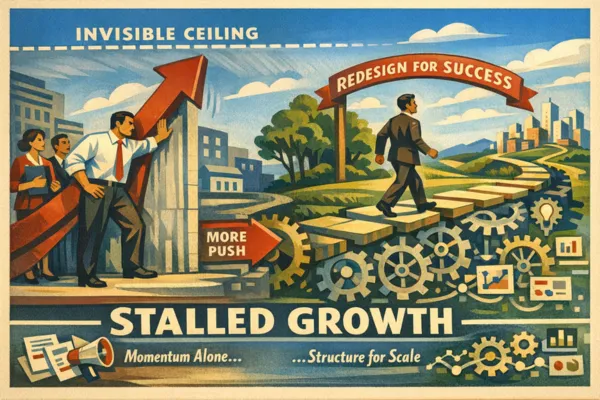
Effort stops working where design is required
One of the most important transitions in a company’s life is the shift from:
effort-driven growth to design-driven growth
In the effort stage:
Leaders push momentum forward
Relationships carry revenue
Talent compensates for missing structure
In the design stage:
Systems create visibility
Ownership creates speed
Architecture creates predictability
Data guides decisions
Execution compounds over time
This is the moment where many successful companies quietly stall. Not because they are weak. Because they are crossing a structural boundary.
And the tools that created early success are no longer enough for the next stage.
The leadership question beneath the slowdown
When growth slows, the most important question is not:
“How do we push harder?”
It is:
“What in our structure is preventing scale?”
That question requires a different kind of leadership.
Not motivational leadership.
Architectural leadership.
Leaders who can step back and see:
How growth truly flows
Where friction is created
Where ownership is unclear
Where systems are disconnected
Where visibility is missing
This is why Warren Buffett’s well known insight remains so relevant:
“Only when the tide goes out do you discover who’s been swimming naked.”
In slower or more disciplined markets, structure is exposed.
And companies built on clarity and design begin to separate from those built on momentum alone.
Quiet stalls can become powerful turning points
The encouraging truth is this:
A stalled season is often the doorway to the strongest period of growth a company has ever experienced.
Because it forces a shift:
From activity to architecture.
From effort to design.
From momentum to predictability.
When leaders address structure directly, several things begin to change:
Revenue becomes visible, not mysterious
Pipelines move with intention
Teams execute with clarity
Marketing begins to compound
Forecasting becomes trustworthy
Growth accelerates again, this time sustainably
Not louder.
Not faster.
But stronger.
The companies that move next
Right now, across the United States, two kinds of successful companies are emerging.
Some will respond to slower growth by pushing harder.
More campaigns.
More meetings.
More urgency.
Same structure.
Others will pause long enough to redesign how growth actually works.
Those companies will enter the next decade with:
Clear revenue architecture
Connected systems
AI-enabled execution
Predictable pipelines
Confident leadership
And they will quietly pull ahead.
A final thought
Stalled growth is not usually a warning sign of failure.
More often, it is an invitation.
An invitation to move from success by momentum
to success by design.
Because the companies that learn to grow intentionally
are the ones that ultimately grow the most.


