
Why Do 85% of AI Projects Fail?
Most AI projects fail not because the technology is broken, but because the business is not ready for it. 85% of AI initiatives never reach production, according to Gartner research. The core reasons are predictable: poor data, missing process design, no ownership, and tools chosen before the system is built. These are solvable problems.
What Does "AI Project Failure" Actually Mean?
Before we diagnose the problem, we need to define it clearly.
AI project failure means an initiative that never reaches production, delivers no measurable business outcome, or gets abandoned after implementation. This is different from a product bug or a bad software vendor.
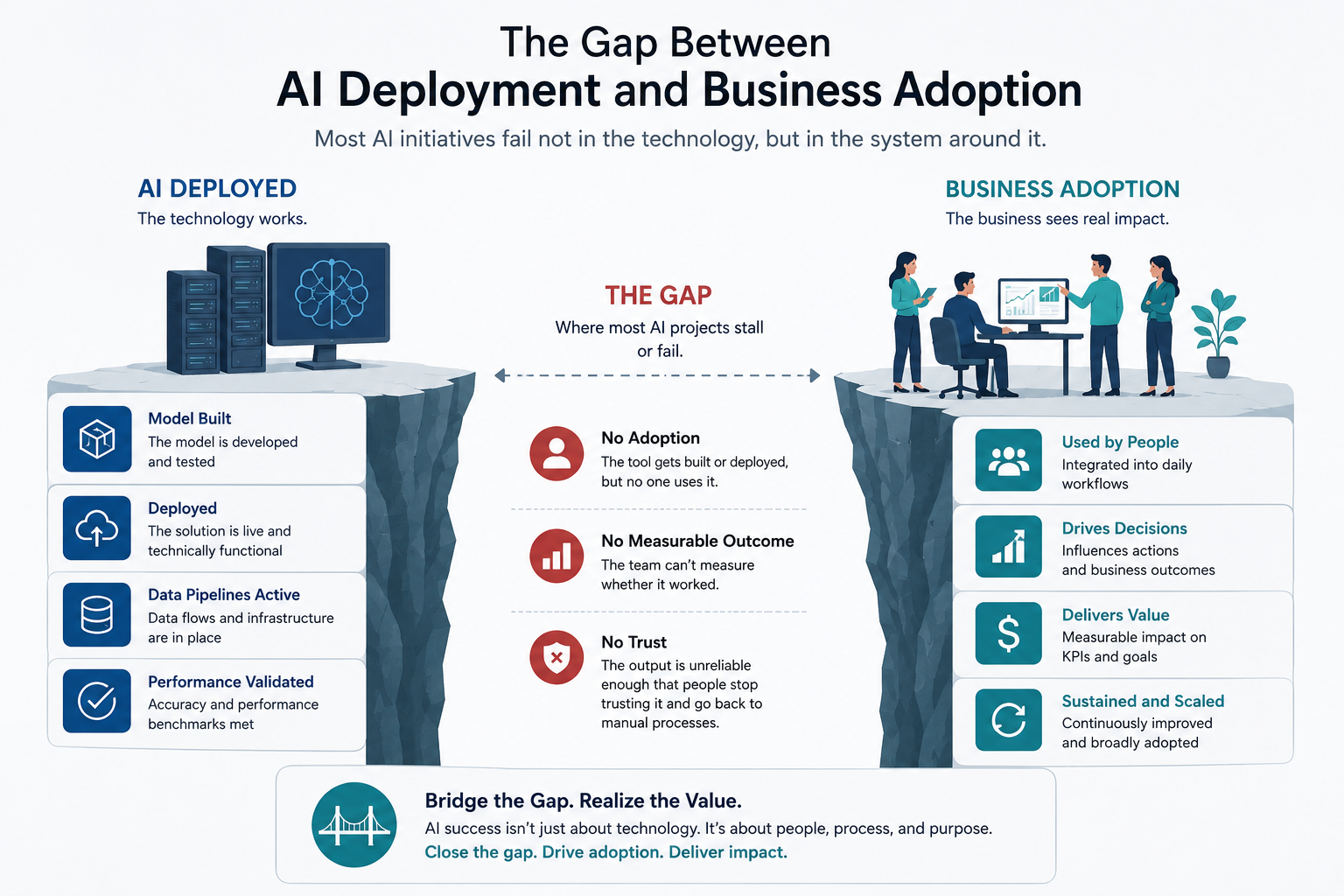
Most failed AI projects end one of three ways:
The tool gets built or deployed, but no one uses it
The team can't measure whether it worked
The output is unreliable enough that people stop trusting it and go back to manual processes
Here's the thing: none of those outcomes are technology failures. They are system failures.
The technology often works exactly as designed. What breaks down is the operating environment around it. No clear ownership, no clean data, no defined process the AI is meant to improve. The tool runs. The business doesn't change.
Why Do Most AI Projects Fail Before They Reach Production?
The honest answer is that most AI projects are designed in the wrong sequence.
Here is what that sequence usually looks like:
Leadership sees a compelling AI demo or reads a case study
A vendor is selected (or a team starts building)
Data gets collected and cleaned (partially)
The tool gets built or configured
The tool gets handed to the team
The team doesn't adopt it
The error happens at step one. The question being asked is "what AI can we use?" when the question should be "what process needs to improve, and would AI help?"
AI tools for business efficiency only work when the workflow they are meant to automate is already understood, documented, and owned. If you cannot describe the current-state process in writing, an AI layer on top of it will accelerate the confusion, not the output.
According to McKinsey's 2023 State of AI report, fewer than 30% of companies embedding AI initiatives embed them inside a structured process improvement program. The rest treat it as a technology deployment, which is why the results are inconsistent.
What Are the Most Common Reasons AI Projects Fail?
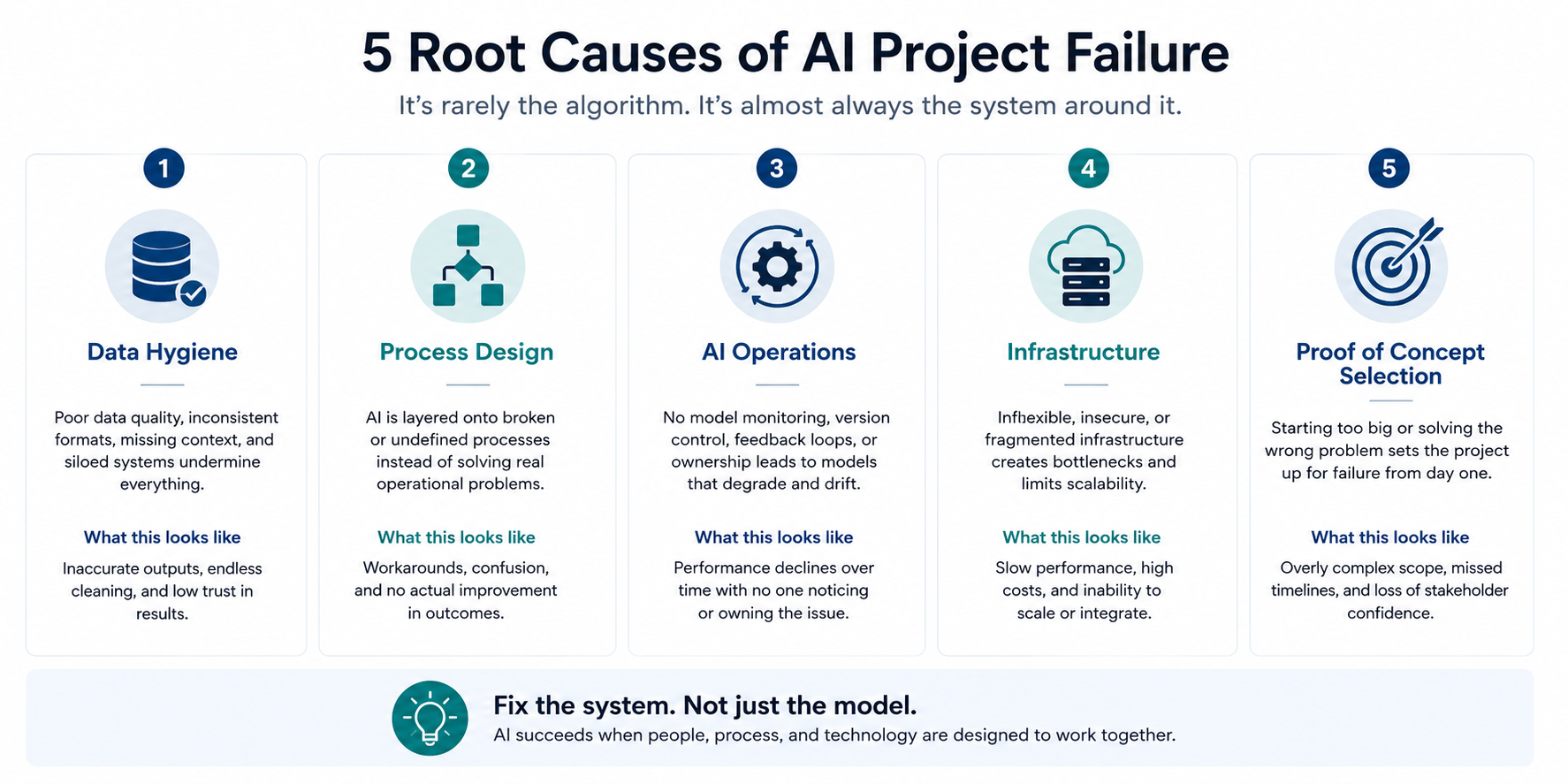
There are five root causes that show up consistently across industries. They are not mysterious.
1. Poor Data Hygiene and Governance
AI systems are only as reliable as the data they train on and operate from.
Most growing companies have data scattered across disconnected tools: a CRM that is not fully adopted, spreadsheets maintained by individuals, email threads that hold critical context, and reporting dashboards that no one fully trusts.
When you build an AI layer on top of fragmented data, the outputs are unreliable. The team notices this quickly. Trust erodes. Adoption drops.
Poor data governance is the single most common technical reason AI projects underperform. Before any AI initiative, the business needs a clear map of: where data lives, who owns it, how it gets updated, and what the standard of quality is. Without that map, you are building on sand.
2. No Clear Process Design Before Tool Selection
This is the sequencing mistake I described above.
Choosing a tool before designing the process is backwards. The tool should serve the process. The process should serve the business outcome. When that sequence is reversed, the tool becomes the point, and the outcome becomes secondary.
I have watched companies spend six months implementing enterprise platforms for workflows that 15-person teams could manage with a $20/month tool. The problem was not the platform. The problem was that no one designed the workflow first, so the platform was never properly configured, and the team was trained on a tool solving a problem that had not been clearly defined.
3. Lack of Proper AI Operations
Deploying an AI tool is not the same as running one.
AI systems require ongoing monitoring, maintenance, and feedback loops. Prompts degrade over time. Data inputs change. Business processes shift. If no one is responsible for managing the AI system after it launches, the output quality drifts, errors accumulate, and eventually the team stops relying on it.
This is what AI operations (AIOps) addresses: the ongoing management layer between the tool and the business result. Most companies skip it entirely because they treat AI deployment as a project with a finish line rather than a capability with a maintenance requirement.
4. Inappropriate Internal Infrastructure
AI tools require connected systems to function well.
If your CRM does not talk to your project management platform, if your intake process lives in an email inbox, if your reporting is built from manual exports, then an AI layer cannot read the full operating picture. It will work with partial information and produce partial results.
Infrastructure readiness is a prerequisite, not a nice-to-have. The business needs integrated systems, clear data flows, and consistent process documentation before AI can multiply what the team does. Without that foundation, AI adds complexity instead of capacity.
5. Failure to Choose the Right Proof of Concept
Many companies start too big.
They try to automate a complex, multi-step process with high variability before they have ever successfully deployed a simple AI task. The scope grows. The timeline extends. The stakeholders lose confidence. The project stalls.
The better approach is to start with a single, well-defined, high-frequency task where the inputs are consistent and the success criteria are clear. Get a win. Build institutional confidence. Then expand scope incrementally.
The best first AI project is the one that is boring, repetitive, and currently draining your best people. Not the flashy use case from the conference keynote.
[Image Placeholder: Five-column graphic listing the root causes of AI failure with brief descriptions. Alt Text: "Infographic of five root causes of AI project failure including data hygiene, process design, AI operations, infrastructure, and proof of concept selection."]
How Does Founder-Dependent Execution Make AI Failure Worse?
There is a pattern I see in nearly every growth-stage company that comes to Revflow.
The founder or a key operator has become the operating system. They hold the context. They make the calls. They know where the data lives and what it means. The business runs because they are running it.
When a company in this state tries to implement AI tools for business efficiency, one of two things happens:
The AI system gets configured around the founder's knowledge, which means it cannot function without them, defeating the purpose
The founder bypasses the AI because it is faster to just do it themselves, which means the tool never gets the usage needed to prove value
The root problem is not the AI. The root problem is that the business does not yet have a documented operating system. The knowledge and process are in someone's head, not in a system. AI cannot automate a process that has not been designed.
The companies that see the best ROI from AI tools are the ones that have already done the foundational work: documented workflows, clear ownership, defined handoffs, and reliable data. AI then multiplies what is already working. It does not create that foundation for you.
What Does a Successful AI Implementation Look Like?
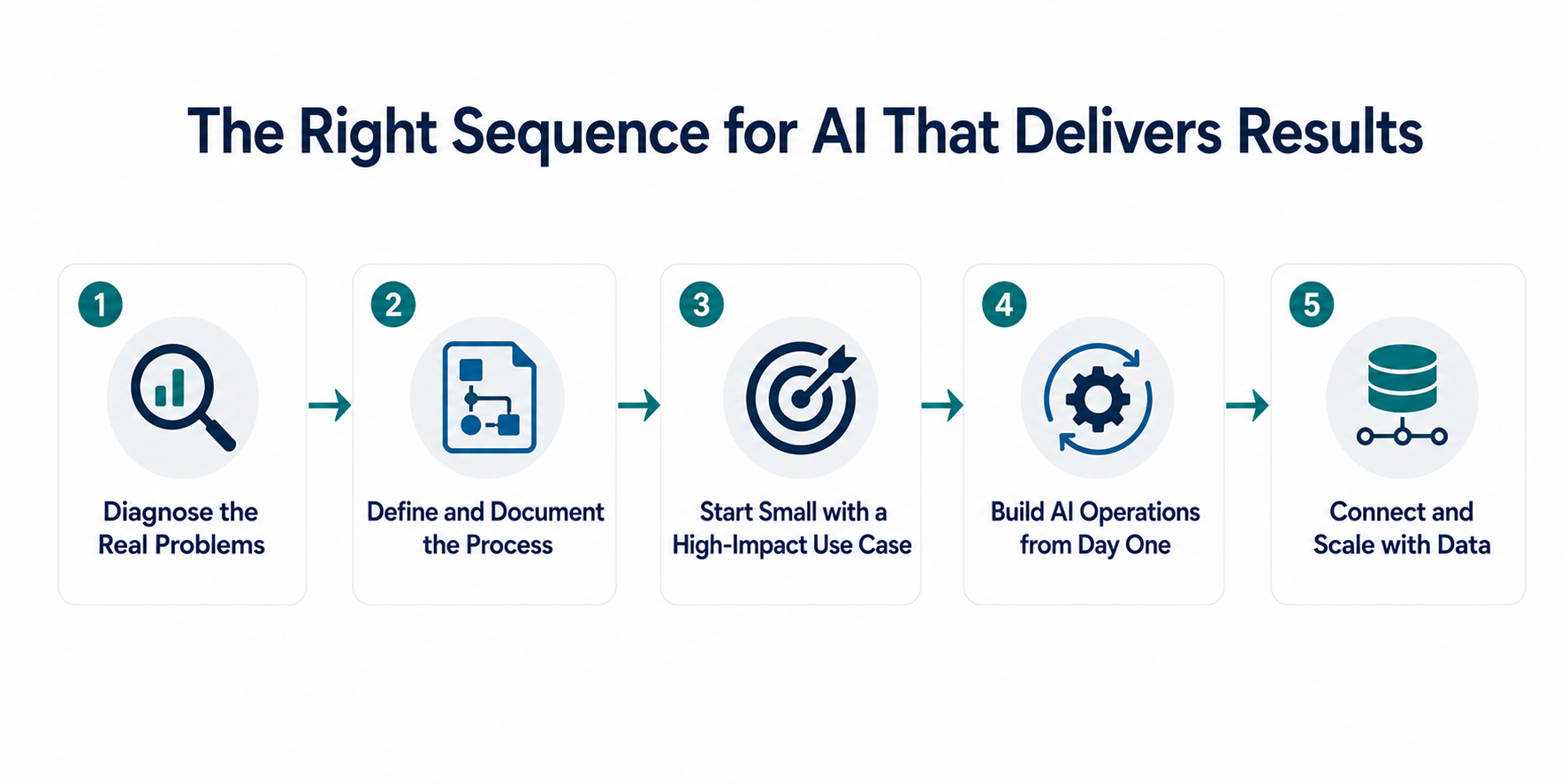
The companies that get AI right follow a consistent sequence.
Step 1: Design the system first
Before any tool is selected, map the current-state workflow. Where do opportunities enter? Where do handoffs break? Where is the human time going? What decisions are being made, and on what information?
This diagnostic step is not glamorous. It takes time. But it is the difference between building an AI system that works and building one that looks impressive for sixty days and then gets abandoned.
Step 2: Define the outcome before the tool
What does success look like? Not in terms of the tool being deployed, but in terms of the business metric it should move. Response time cut in half. Lead follow-up happening within ten minutes of inquiry. Proposals generated in thirty minutes instead of three hours. Specific, measurable, owned.
Step 3: Start small and earn the infrastructure
Pick the smallest viable proof of concept. Deploy it. Measure it. Fix what breaks. Document what works. Then expand.
This approach sounds slower. It is not. It is the approach that reaches ROI. The big-bang deployments that skip steps one and two are the 85%.
Step 4: Build the operations layer
Assign ownership of the AI system to a specific person. Define the feedback loop. Set a review cadence. Treat the system like infrastructure, not a one-time project. It needs maintenance, monitoring, and iteration.
Step 5: Connect the tools to the data
Make sure the AI system can see the information it needs to produce reliable output. This usually requires CRM hygiene, integration work, and standardizing how data enters the system. Infrastructure readiness is not optional.
How Should Small and Mid-Size Businesses Approach AI Tools for Business Efficiency?
Here is a contrarian take that I hold firmly: most growing businesses should implement far less AI than they think they need, and far more process clarity than they currently have.
The pressure to adopt AI is real. The case studies are compelling. The vendors are persuasive. But the businesses in those case studies almost always had the foundational infrastructure in place before they started. They had clean CRM data, documented workflows, defined ownership, and a culture of measurement. The AI amplified what was already working.
For a founder-led company still running on heroic execution, the most valuable investment is not the AI tool. It is the operating system that makes the AI tool useful.
Build the foundation. Document the process. Clean the data. Define ownership. Then automate. In that sequence, AI works exactly as advertised.
In the reverse sequence, it produces one more expensive tool that no one fully adopts.
Pro Tip: Before evaluating any AI vendor or tool, run a two-week internal audit. Map every repetitive task that consumes more than two hours per week. Document the inputs, outputs, and decision rules for each one. That list becomes your AI roadmap, sequenced by ROI potential. Start at the top, not the most exciting item on the list.
[Image Placeholder: Flowchart of the correct AI implementation sequence: diagnose, define, start small, build operations, connect data. Alt Text: "Step-by-step flowchart showing the right sequence for implementing AI tools for business efficiency in a growing company."]
AI Tools for Business Efficiency: Build vs. Buy vs. Configure
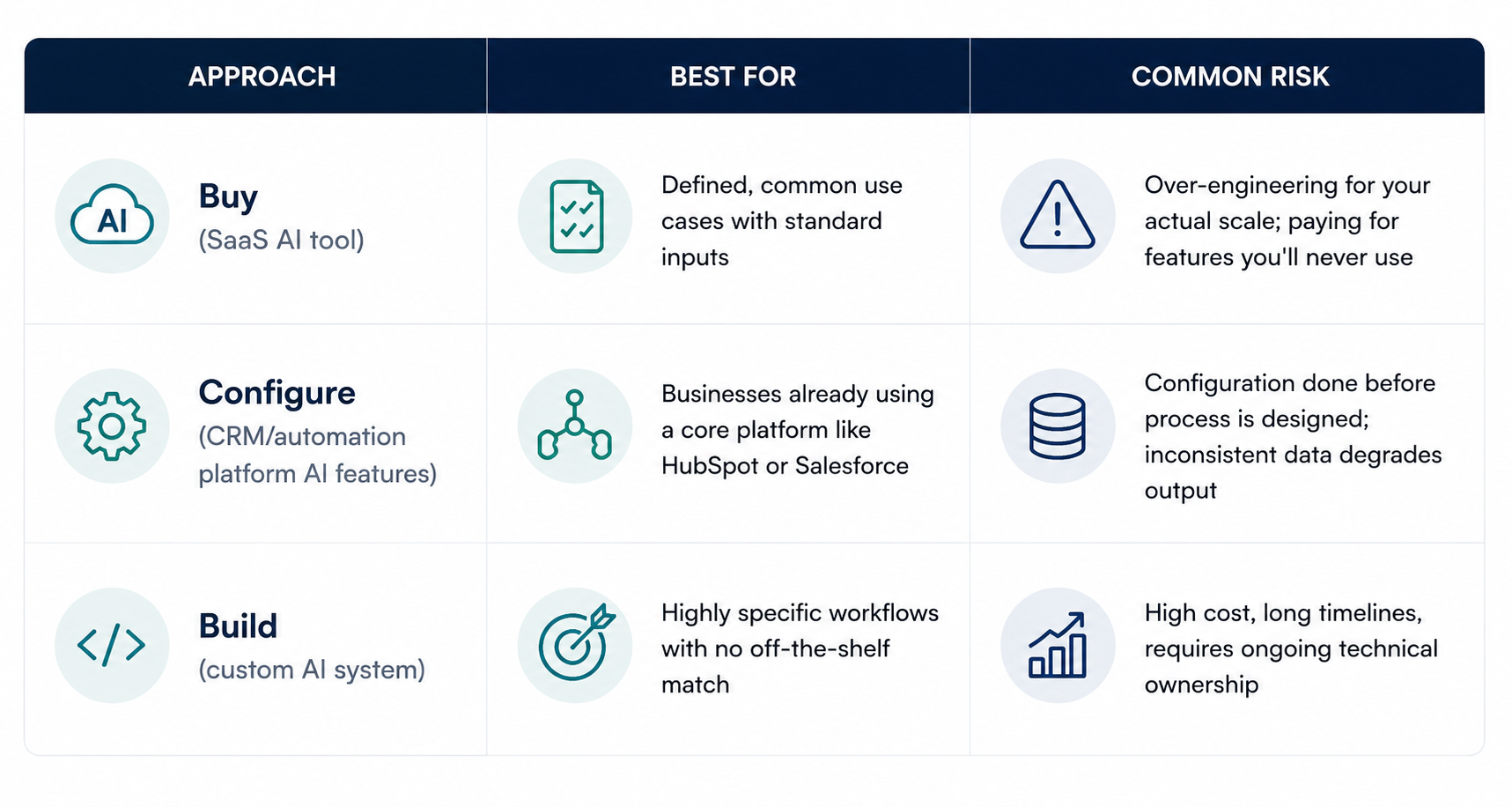
One of the questions that surfaces early in every AI engagement is whether to build a custom solution, buy a pre-built tool, or configure an existing platform.
The right answer depends on the problem being solved, not on which option sounds most sophisticated. I have seen 15-person teams drown under enterprise platforms that a $30/month tool would have handled cleanly. The most efficient infrastructure is the one that matches your actual operating scale, not the scale you think you need to appear professional.
Frequently Asked Questions About Why AI Projects Fail
What percentage of AI projects fail?
According to Gartner, approximately 85% of AI projects fail to move from pilot to production or fail to deliver measurable business ROI. The primary causes are poor data quality, missing process design, lack of AI operations ownership, and inadequate infrastructure readiness before deployment.
What is the most common reason AI implementations fail?
The most common reason AI implementations fail is choosing the tool before designing the process. When a business selects an AI solution without first documenting the workflow it is meant to improve, the tool gets configured around assumptions instead of operating reality, and adoption collapses within the first ninety days.
Can small businesses benefit from AI tools for business efficiency?
Yes, but the path to ROI for small businesses is narrower than for enterprise. Small businesses should start with a single, well-defined, high-frequency task, use simple affordable tools before custom builds, and prioritize data hygiene and CRM adoption before layering in AI. Process clarity is the prerequisite.
What is AI operations and why does it matter?
AI operations (AIOps) refers to the ongoing management, monitoring, and maintenance of AI systems after deployment. It matters because AI tools degrade without active oversight: prompts drift, data inputs change, and errors accumulate. Without an AIOps function, even well-designed AI systems fail within months of launch.
How do you know if your business is ready for AI?
Your business is ready for AI when you can describe your core workflows in writing, your data is consistently maintained in a central system, ownership is clear on every key process, and you have a specific measurable outcome the AI is meant to move. If any of those conditions are missing, the highest-ROI investment is closing that gap first.
What is the best first AI project for a growing company?
The best first AI project is the one that is repetitive, high-frequency, and clearly defined. Look for tasks where the inputs are consistent, the decision rules are known, and the time cost is significant. Common strong starting points include lead follow-up sequences, proposal generation, meeting summaries, and internal reporting. Start boring, get a win, then expand.
How does poor data quality affect AI outcomes?
Poor data quality produces unreliable AI outputs, which erodes team trust, which kills adoption. AI systems trained on or operating from incomplete, inconsistent, or fragmented data cannot deliver consistent results. Clean data is not a nice-to-have. It is the technical foundation that determines whether the AI system functions reliably.
What Should You Do If Your AI Initiative Is Stalling?
If your AI project is not delivering, the fix is almost never the tool.
Start here. Ask three questions:
One. Is the workflow this AI is meant to improve fully documented, with clear inputs, outputs, and ownership?
Two. Is the data this AI depends on clean, consistent, and maintained in a single source of truth?
Three. Does a specific person own the ongoing operation and quality of this AI system?
If any answer is no, you have found the constraint. Fix that before changing tools, adding features, or expanding scope.
The 15% of AI projects that succeed are not using better technology. They are operating with more clarity. They designed the system first, chose tools that matched their actual scale, and built the infrastructure needed to make the AI reliable.
That sequence is available to any business willing to do the diagnostic work before the deployment work.
At Revflow, we spend the first six weeks embedded inside a business doing exactly that diagnostic. We map how work actually flows, where leadership capacity is being consumed, where the handoffs break, and where AI and automation can multiply the team's best work. The Growth Playbook that comes out of that engagement is an owned blueprint, not a retainer dependency. The client walks away with a clear operating system design, a sequenced roadmap, and the infrastructure requirements defined before a single tool is selected.
That sequence is why the implementations that follow it hold up under real conditions. Build the system first. Then automate it.
If your growth is stalling because execution is not matching ambition, that is a systems problem. And systems problems have designed solutions.


